
The Protective Effect of Sense of Meaning: A Study on the Relationships Between Structural Academic Stress, AI Replacement Anxiety, and Mental Health Among University Teachers
Abstract
Against the dual backdrop of performance-oriented governance and the rapid development of artificial intelligence, faculty mental health has become an increasingly important issue. Its causes now extend beyond individual stress, reflecting a structural imbalance between institutional conditions and psychological resources. Focusing on university faculty in China, this study examines how structural academic pressure and anxiety about AI-related replacement influence mental health, and tests the mediating role of sense of meaning and the moderating role of perceived organizational support. Drawing on the Job Demands–Resources (JD–R) model and Conservation of Resources (COR) theory, the study employs structural equation modeling (SEM) based on 150 valid responses. The results show that both structural academic pressure and AI-related replacement anxiety have significant negative effects on mental health, with structural pressure exerting the stronger impact. Sense of meaning functions as a significant mediator, indicating that faculty maintain psychological balance through reconstructing professional values and reaffirming purpose in their work. Perceived organizational support plays a moderating role by reducing the negative influence of institutional and technological stressors and by reinforcing the positive impact of meaning on mental health. The overall model fit is satisfactory (χ²/df = 1.57, CFI = 0.97, TLI = 0.96, RMSEA = 0.04), supporting the framework that links institutional structures and psychological resources in shaping faculty mental health. The study concludes that university teachers’ psychological difficulties are not isolated emotional reactions but structural outcomes of performance-driven governance and the weakening of humanistic values. Improving faculty mental health requires shifting educational governance toward human-centered values and restoring institutional trust and recognition of academic work. Theoretically, the study advances a structural understanding of how mental health is shaped, and practically, it provides empirical evidence and policy implications for improving faculty support systems and reforming higher education governance.
Introduction
Performance Based Governance in Global Higher Education and the Structural Evolution of Academic Pressure: The Institutional Roots of Faculty Mental Health Challenges
Amid rapid transformations in global higher education, faculty mental health has shifted from an individual stress issue to an institutional risk, rooted in the intensification of performance-driven academic governance and structural assessment regimes. Whereas faculty stress was once attributed mainly to personal time management and workload, it has now taken on a structural form that is increasingly institutionalized and internationally diffused. Since the early twenty-first century, universities have been systematically incorporated into a regime of metric governance centered on performance indicators (Burrows, 2012). Quantitative measures such as research output, citation counts, and the h-index have become the main criteria for evaluating scholarly value. The logic of educational governance has shifted from the self-regulation of a scholarly community to performance-driven organizational control. Academic work has been normalized as a form of “digital competition,” in which faculty must continually justify their presence and worth under datafied surveillance. This quantification-driven model has transformed the academic ecosystem and reshaped faculty professional identity and emotional experience. The structural logic is particularly evident in advanced economies such as the United Kingdom and the United States.In the United Kingdom, the Research Excellence Framework (REF) links periodic assessment and league table ranking with institutional reputation and resource allocation, binding them closely to research performance. As a result, faculty face what Derrick, Watermeyer, and Batalla (2022) describe as an “affective auditing” regime, in which pressure to produce outputs is accompanied by growing self-doubt, evaluation anxiety, and professional alienation. In the United States, performance-based funding has pushed this logic further. Although intended to incentivize improvements in teaching and research, empirical studies show that it has instead fostered motivational displacement, increased research-related anxiety, and reduced educational equity in practice (Ortagus, Kelchen, Rosinger, and Voorhees, 2020).Overall, the evidence suggests that performance regimes have not improved educational quality as intended by policymakers. Instead, metrics pressure and competitive incentives have eroded teachers’ psychological safety and professional well-being. As this logic has spread to the Global South and newly developing higher education systems, it has generated comparable mental health challenges. In South Africa’s open and distance university sector, for instance, Poalses and Bezuidenhout (2018) report that faculty are widely in a high-risk psychological state, characterized by sustained stress, emotional exhaustion, and burnout. This psychological predicament is not the result of inadequate personal coping but a structural consequence of persistent pressure within performance governance regimes.Similar patterns are evident in Asia’s emerging academic systems. Empirical studies from China show that university faculty have experienced a marked rise in work stress in recent years, which, through emotional burnout, diminishes life satisfaction and mental health (Xu & Wang, 2023). These findings indicate that a performance-oriented academic culture is systematically depleting teachers’ psychological resources and overall quality of life. Global evidence shows that, across both established systems such as the UK and US and rapidly reforming systems in developing regions, faculty mental health follows a consistent pattern of institutionalized stress. Structural academic pressure is no longer a byproduct of workload or time conflicts; it has become a psychological risk embedded in governance logics.Through quantitative evaluation, resource competition, and identity auditing, these regimes reshape the meaning of academic work and gradually deplete emotional resources, erode meaning, and undermine professional well-being. Within this high-pressure environment, the deterioration of faculty mental health has become a shared concern for higher education systems worldwide. Understanding the mechanisms that produce this structural pressure is no longer solely a concern of educational psychology but a central issue for the sustainable development of higher education.
The Expansion of Artificial Intelligence and the Evolution of Replacement Anxiety:Mental Health Risks in Knowledge Work
Existing research has deepened understanding of the relationship between AI-related anxiety and occupational mental health, yet theoretical integration remains limited and structural explanations incomplete. Studies have shown that technological change can create job insecurity, cognitive threat, and emotional distress (Wang & Wang, 2019; Yam et al., 2023; Koch & Lodefalk, 2025), but most stay within a one-way “threat–stress” framework. They provide limited insight into how individuals maintain psychological stability and meaning under structural risks. In other words, while research on AI anxiety has described the external situation of humans being displaced by technology, it has paid less attention to the internal processes through which individuals resist such displacement. This theoretical gap constrains understanding of how knowledge workers develop psychological defense mechanisms when facing the dual pressures of technological intelligence and performance-based governance.Research on meaning in life offers a useful psychological perspective on this issue. Allan et al. (2016) identify meaning as a key psychological resource linking external stressors to internal resilience. In a longitudinal study, Herr et al. (2023) find that meaning helps sustain and strengthen individuals’ mental health over time. Studies in educational contexts by Zhang et al. (2024) and Yildirim et al. (2024) also confirm its buffering effect against high pressure and performance anxiety. Although these studies provide strong empirical evidence for the protective role of meaning, they largely focus on general occupational groups and pay insufficient attention to knowledge workers—such as university faculty—who face institutional performance constraints and increasing AI involvement.Theoretically, the study of meaning has shifted from an outcome-oriented to a resource-oriented perspective. Martela et al. (2021) propose a dual-path model of autonomy and prosociality, suggesting that meaning supports intrinsic motivation and reinforces social value, which together help individuals maintain psychological balance under institutional and technological pressures. Drawing on Conservation of Resources (COR) theory and the Job Demands–Resources (JD–R) model, meaning is viewed not simply as an outcome of well-being but as a psychological resource that protects, restores, and regulates individuals when they experience external stress. This provides a theoretical basis for understanding mental health in the context of AI-related anxiety and structural pressures.However, several gaps remain in the current literature. First, studies on AI-related anxiety have focused mainly on affective threat perception, with few models that situate it within a psychological resource framework. Second, most studies examine performance pressure or technological anxiety separately, overlooking their combined effects in institutionalized educational settings. Third, although meaning in life has been validated as a psychological resource, its mediating and moderating roles in the relationships among structural academic pressure, AI replacement anxiety, and mental health have not been systematically tested. These gaps limit the development of an explanatory framework that connects institutional conditions, technological change, and psychological resources. In response, this study integrates the JD–R model and Conservation of Resources theory to propose a meaning-centered framework of psychological protection. It examines how meaning functions as a buffer and restorative resource under the dual stressors of structural performance pressure and AI-related replacement anxiety, thereby supporting university teachers’ mental health.
Proposed hypotheses:
H1: Structural academic pressure exerts a significant negative effect on university teachers’ mental health. H2: Anxiety about AI driven replacement exerts a significant negative effect on university teachers’ mental health. H3: Sense of meaning mediates the relationship between structural academic pressure and mental health. H4: Sense of meaning mediates the relationship between AI replacement anxiety and mental health. H5: Sense of meaning moderates the adverse effects of structural pressure and AI anxiety on mental health, such that higher levels of meaning weaken these negative impacts.
Meaning as a Psychological Resource and Protective Mechanisms for Mental Health: Building the Research Model
As structural performance pressure and AI-related anxiety have become major sources of stress for knowledge workers worldwide, scholars have renewed attention to “meaningfulness” as a positive psychological resource that helps individuals cope with external demands and sustain mental health and professional continuity. Meaningfulness concerns not only subjective well-being at work but also how people preserve self-worth and a coherent moral order within increasingly institutionalized and technologized environments. The development of meaning research shows a shift from treating it mainly as an affective outcome to recognizing it as a psychological resource and mechanism.In the early twenty-first century, the integration of positive and occupational psychology promoted the concept of “meaningful work,” highlighting perceived meaning as a key source of resilience. Drawing on a North American sample, Allan et al. (2016) found that a sense of meaning can buffer emotional exhaustion and existential anxiety in high-pressure contexts, allowing individuals to maintain a coherent sense of purpose when confronting job demands. This study was among the first to clarify the interaction between meaning and mental health, showing that meaning functions not only as an outcome of well-being but also as a mediating resource for stress resistance.European research further confirmed the dynamic role of meaning over time. Herr et al. (2023) identified a lasting positive relationship between meaningful work and mental health: meaning not only enhances short-term well-being but also influences psychological well-being trajectories over time. This finding suggests that meaning is not a fixed trait but a cumulative psychological resource. In the 2020s, scholarly attention turned to educators and public service professionals. Yildirim et al. (2024) reported that, among teachers, meaning enhances psychological flexibility and coherence, helping to reduce anxiety and emotional strain in high-pressure environments. Similarly, Zhang et al. (2024) found that in performance-intensive East Asian education systems, a sense of meaning weakens the impact of hindrance stressors on turnover intentions and increases teachers’ engagement at work. Collectively, these findings indicate that meaning serves as a strong psychological buffer in high-pressure educational contexts, protecting teachers working under structural performance demands.At the theoretical level, Martela et al. (2021) proposed a dual-pathway model of autonomy and beneficence, showing that meaning sustains intrinsic motivation and reinforces social value through these two paths and mediates the relationship between external working conditions and internal psychological states. This perspective marks a theoretical shift from an outcome-oriented to a resource-oriented approach and provides a new analytical lens for studying mental health.Nonetheless, several important gaps remain. First, most existing studies focus on general occupational groups and have not incorporated the combined context of institutional performance pressure and technology-related anxiety faced by knowledge workers such as university faculty. Second, although previous studies have demonstrated the protective role of meaning, its function within the relationships among structural academic pressure, AI-related replacement anxiety, and mental health has not been systematically examined. Current discussions of meaning remain rooted in individual, subjective well-being models and lack structured analysis of its “psychological defense” and “resource regulation” mechanisms.Building on the Job Demands–Resources (JD–R) framework and Conservation of Resources (COR) theory, this study develops a meaning-centered framework of psychological protection. The model specifies how meaning buffers and restores mental resources under the dual stressors of structural performance pressure and AI-related replacement anxiety, thereby supporting the mental health of university faculty. In doing so, it advances theoretical understanding of meaning as a psychological resource and provides empirical and policy insights for organizational interventions in higher education.
Literature Review
Structural Academic Pressure and Faculty Mental Health
In recent years, faculty mental health has come to be recognized as one of the most structurally embedded risks within higher education systems. Cross-national evidence consistently shows that performance-based evaluation, institutional uncertainty, and inadequate organizational support are the main structural stressors contributing to psychological distress among academics (Abraham, Meyer, Mokwena, & Duncan, 2025). Empirical studies in South Africa further demonstrate that psychological strain is closely related to organizational culture, suggesting that institutional conditions, rather than individual dispositions, are the primary drivers of deteriorating mental health.Yet much of this research has focused mainly on identifying risks and provides limited analysis of the underlying structural mechanisms. In a scoping review, Agyapong, Obuobi-Donkor, Burback, and Wei (2022) observe that anxiety, depression, and occupational burnout among faculty have become global concerns, but most studies rely on cross-sectional designs and lack theoretical integration to explain the long-term mechanisms through which “structural academic pressure” operates. European scholarship has begun to examine the interaction between mental health and work engagement. Angelini et al. (2024) show that emotional burnout is not a single negative outcome; its different dimensions influence well-being and engagement in various ways, suggesting that “burnout” is multifaceted and potentially reversible, with implications for the design of psychological interventions.From an economic–sociological perspective, Cerci and Dumludag (2019) argue that income disparities and performance-oriented evaluation regimes reduce faculty job satisfaction and overall life satisfaction, revealing a sense of relative deprivation and structural imbalance in academic work. Evidence from the Middle East supports this institutional interpretation: Hammoudi Halat et al. (2024) report that, in Qatari universities, perceived occupational stress is strongly and positively related to depressive and anxiety symptoms, showing a close link between high-performance academic cultures and deteriorating mental health.Further qualitative research highlights the impact of weak institutional support on faculty well-being. Through in-depth interviews with health sciences educators, Koster and McHenry (2023) show that the absence of organizational backing, blurred work–life boundaries, and unequal resource allocation together create conditions for burnout, challenging traditional, individual-centered stress models. Complementing this, Madigan et al. (2023) report in a systematic review that teacher burnout leads not only to psychological exhaustion but also to physical health problems, revealing its multidimensional and systemic consequences. However, such reviews often overlook the complexity of how social institutions jointly shape psychological and physiological health. Recent work in Thailand by Pakdee, Cheechang, and Thammanoon (2025) emphasizes the importance of cultural context, arguing that social expectations and role obligations in collectivist environments intensify the psychological effects of performance pressure, thereby strengthening the link between burnout and reduced well-being.Existing studies consistently show the widespread decline of faculty mental health under structural academic pressures, but most still lack theoretical depth and methodological integration. Few studies provide a systematic account of how institutional logics, organizational culture, and individual psychology interact. Most focus narrowly on symptoms while neglecting the institutional dynamics that generate them. Future research should adopt a dual structural–psychological perspective to explore how performance-based governance affects faculty mental health through organizational support and meaning-making processes, helping to reinterpret structural pressure from a psychological standpoint. Such a shift could bridge the gap between macro-level policy and micro-level experience and provide a stronger theoretical basis for structurally informed educational and psychological interventions.
AI Displacement Anxiety and Resource Threats
Although existing evidence on AI-induced displacement anxiety and resource threats generally points in a similar direction, there remain disputes over how technologies are measured, how causality is identified, and how findings can be generalized across contexts. A more critical synthesis is required to clarify conceptual boundaries and causal mechanisms. Studies at the industry and national levels provide relatively exogenous leverage. Analyses exploiting the expansion of industrial robots, for example, link technological exposure to declining worker mental health, indicating that objective technological change can translate into lasting psychological risks. This pattern appears consistent across sectors. However, robot intensity primarily captures physical automation and does not fully represent generative intelligence or algorithmic systems that affect knowledge work (Abeliansky, Beulmann, & Prettner, 2024).In Europe, evidence from Germany suggests that higher AI intensity is associated with greater job stress, particularly in knowledge-intensive roles. This finding reinforces concerns about cognitive substitution. Yet the analysis relies mainly on cross-sectional associations, which makes it difficult to exclude reverse causality—for instance, that high-pressure positions may be more likely to adopt AI—and collinearity between technological intensity and job characteristics further complicates causal attribution (Koch & Lodefalk, 2025).At the organizational and individual levels, further evidence shows how subjective threat perceptions form. Multi-method studies find that introducing intelligent systems heightens insecurity and provokes maladaptive behaviors such as avoidance and defensiveness, indicating that perceived threats can manifest in behavioral outcomes. Even so, the external validity of these findings across experimental designs and situational manipulations remains to be confirmed (Yam, Tang, Jackson, Su, & Gray, 2023). Process-level innovation can also increase psychological strain by reorganizing tasks and redefining performance requirements, producing greater tension and stress. This highlights that the interaction between technology and managerial practice constitutes the real exposure pathway, and analyzing technology in isolation may underestimate the role of institutional and organizational factors (Du, Shahiri, Wei, & Xiahai, 2023).From a resource-based perspective, studies indicate that AI-induced insecurity reduces knowledge sharing and exploration, whereas AI self-efficacy can offset these negative effects. However, most measures rely on self-reported data, raising concerns about common method bias, and the influence of cultural context on self-efficacy has not been adequately examined (Kim & Kim, 2024). Integrated models that include AI cognition, career resilience, and job insecurity suggest that resilience contributes to stabilizing behavioral outcomes. Yet the conceptual distinction between resilience and self-efficacy, as well as their temporal stability, remains insufficiently supported by multi-wave longitudinal evidence (Chung, Im, Kim, & Yun, 2025). Micro-level experiments exploring immediate emotions show that simply interacting with an AI physician can elevate state anxiety even without actual job displacement, implying that threat cues alone can trigger anxiety, though the ecological validity and long-term implications of such findings remain uncertain (Yang & Sundar, 2025).Overall, objective indicators of technological intensity help identify the scope of impact; subjective threat perceptions reveal how psychological states translate into behavior; and resource-based factors such as self-efficacy and career resilience suggest potential buffering mechanisms. Nonetheless, mismatches between measures of technological intensity and job content, endogeneity from common-source and cross-sectional data, and the neglect of cultural and organizational contexts limit the generalizability and policy relevance of current findings.In response, this study uses task-level indicators of AI exposure and integrates longitudinal and multi-source data to distinguish between two exposure pathways: process redesign and tool adoption. Within the university context, we also include social and institutional resources such as perceived meaningfulness and organizational support. The aim is to examine the coupling strength between objective exposure and subjective threat and to assess how resource buffers moderate psychological outcomes. This design seeks to address key limitations in existing research concerning measurement precision, causal inference, and contextual scope.
Meaningfulness and Mental Health
Across industries and cultural settings, research generally finds a positive association between meaningfulness and mental health, although differences in theoretical foundations, measurement strategies, and contextual factors limit the scope of this conclusion. Using the pandemic and other high-pressure situations as external shocks, Jalil and Ali (2023) show in a sample of SMEs that the subjective experience of meaningful work improves psychological outcomes indirectly by fostering adaptive coping strategies. This finding indicates that meaningfulness is not a fixed trait but a flexible psychological resource that can be strengthened through resource mobilization and cognitive reappraisal. However, the study relies on cross-sectional self-reports; personality orientation and organizational climate may introduce common method bias, and causal direction requires a more rigorous identification strategy.In high–emotional labor occupations, Pace, Sciotto, and Russo (2022) find a robust association between meaningfulness and work enjoyment, though the effect varies depending on emotion regulation strategies. In particular, the costs of deep acting can offset part of the positive impact. This result highlights the importance of examining the short-term costs and temporal dynamics of emotional labor when evaluating the protective role of meaningfulness.Cross-sectional evidence from university systems worldwide shows that staff health and well-being have come under broad pressure in the post-pandemic period (Rahman et al., 2024). This highlights the urgency of examining the buffering function of meaningfulness within university organizations and reveals a key gap: large-scale monitoring rarely measures meaningfulness directly, making it difficult to explain why individuals differ so widely under comparable levels of stress. At the individual level, Rinas, Dresel, and Daumiller (2022) examine subjective well-being through an achievement-goal framework. Although they do not directly assess meaningful work, their findings suggest that meaning-making may stabilize well-being by strengthening mastery goals and weakening avoidance goals. This inference calls for integrated testing within a single model that jointly includes meaningfulness, goal orientation, and psychological outcomes.Broader research on teachers indicates that emotional well-being is a multidimensional construct. The tripartite model proposed by Salavera and Urbón (2024), encompassing affective, cognitive, and social components, provides a framework for examining how meaningfulness affects these dimensions and how their sensitivity to it may differ.Overall, the evidence points to a consistent mechanism: under stress, meaningfulness functions as a psychological resource that can be activated through deliberate strategies, and its effects depend on the intensity of emotional labor, individual motivation, and the organizational environment. Future studies on teachers should employ multi-wave and multi-source designs, track short-term changes in meaningfulness alongside the costs of emotional labor, and incorporate organizational variables such as support, fairness, and job autonomy to produce balanced interpretations. Analyses should also disaggregate outcomes to examine differences across affective well-being, psychological distress, and occupational burnout.Such a design builds on the process-oriented insights of Jalil and Ali (2023) and Pace et al. (2022), addresses the mechanism gap identified by Rahman et al. (2024), and connects the motivational framework of Rinas et al. (2022) with the multidimensional measurement model proposed by Salavera and Urbón (2024). This approach enables a clearer delineation of the protective capacity of meaningfulness and identifies intervention pathways under conditions of institutional pressure and technological uncertainty in higher education.
Theoretical Integration and Formulation of Research Hypotheses
Current research on university teachers’ mental health has moved from identifying risks to explaining underlying mechanisms. The main challenge lies in theoretically integrating how institutional stress, technological anxiety, and psychological resources interact. Broström, Buenstorf, and McKelvey (2021) noted that in the era of the knowledge economy and innovation-driven development, universities have been reshaped into performance- and output-oriented innovation hubs. Teachers are no longer simply knowledge disseminators but have become production factors in institutional competition. This transformation has placed them in a sustained imbalance between high demands and limited resources, forming an institutional root for the structuralization of mental health problems.However, research on institutional structures often overlooks teachers’ subjective experiences and adjustment processes, offering few mechanisms to explain micro-level psychological dynamics. From a cultural-critical perspective, Sparkes’ (2021) study of academic narratives revealed that under performative and quantitative governance, academic work has been “indexed.” Teachers experience self-alienation and meaning erosion amid constant evaluation cycles. This institutional logic contributes to job burnout and erodes the spiritual foundation of academic work. While Sparkes’ contribution is theoretically insightful, it lacks empirical validation of the underlying psychological mechanisms.Using performance-based funding policies as a case, Rosinger, Ortagus, Kelchen, and Choi (2023) showed that when evaluation systems overemphasize quantifiable indicators, teachers’ behaviors and psychological states become simultaneously alienated. The original aim of performance incentives shifts toward “punishment-driven motivation,” creating an organizational pathway that helps explain how structural academic stress translates into psychological distress. In parallel, Maddock’s (2024) study of social work professionals identified covariation among stress, burnout, and well-being, showing that in high-pressure environments, the depletion of psychological resources generates a negative feedback loop in which reduced well-being and increased burnout reinforce one another. This provides a cross-professional reference for understanding mental health in education, although its static model fails to capture the dynamics of cognitive resource recovery and adjustment.To address this limitation, Scholze and Hecker (2024) proposed adopting the Job Demands–Resources (JD–R) model as a core theoretical lens for mental health in the digital age. They argue that technological and institutional changes can simultaneously increase stressors (demands) and foster new psychological resources, among which sense of meaning, self-efficacy, and organizational support are key variables. This model integrates structural stress and AI anxiety and conceptualizes mental health as a dynamic equilibrium between stress and resources rather than a linear causal chain. Sinval, Oliveira, Novais, Almeida, and Telles Correia (2024) validated this view in a longitudinal study of medical students, finding that stress, anxiety, and academic engagement interact dynamically over time. Mental health thus emerges as a state system shaped by ongoing processes of resource depletion and recovery.Overall, existing research has identified multiple determinants of teachers’ mental health—spanning institutional logic, cultural critique, policy design, and psychological mechanisms—but cross-level integration remains limited. Drawing on the JD–R model and Conservation of Resources (COR) theory, this study develops a three-dimensional model in which structural academic stress and AI replacement anxiety constitute external job demands that affect teachers’ mental health through a resource-threat pathway. As a key psychological resource, a sense of meaning helps regulate resource consumption under institutional and technological pressures and supports psychological recovery by reconstructing internal motivation.This integrated model responds to the institutional stress logic identified by Broström et al. (2021) and Rosinger et al. (2023) while incorporating the resource-balance perspective advanced by Scholze and Hecker (2024). It also formulates a psychological countermeasure hypothesis based on Sparkes’ (2021) diagnosis of the “collapse of academic meaning.” Accordingly, the study proposes three hypotheses:(1) Structural academic stress and AI replacement anxiety significantly reduce teachers’ mental health;(2) Sense of meaning mediates or moderates the relationship between these stressors and mental health;(3) Organizational support and teacher autonomy enhance the protective effect of meaning.Through this framework, the study links institutional critique with psychological modeling, constructing a theoretical pathway that combines the explanatory reach of social structure with the testability of psychological processes..
Methods
Research Objec
This study explores the structural formation of mental health and the regulation of psychological resources among university teachers, within the dual context of performance-oriented governance and the rapid penetration of artificial intelligence (AI). Guided by the framework of structural stress–psychological resources–mental health, it examines how structural academic stress and AI replacement anxiety jointly influence teachers’ mental health, focusing particularly on the mediating role of sense of meaning and the moderating role of organizational support.Unlike previous studies that focused mainly on individual stress responses, this research adopts a dual perspective—social institutions and psychological resources—to explain the structural roots of mental health problems. Using data from 150 university teachers, the study identifies major psychological risks, compares the relative impacts of institutional stress and technological anxiety, examines how teachers sustain psychological balance through meaning construction, and analyzes the role of organizational support in recovery.Theoretically, the study integrates the Job Demands–Resources (JD–R) model and Conservation of Resources (COR) theory to construct a mental health generation framework centered on sense of meaning. It views mental health not as an individual trait, but as the outcome of interactions between institutional logic and psychological resources. Practically, the study provides new insights for improving institutional care in educational governance. Strengthening organizational support and meaning-supply mechanisms can foster teachers’ sustainable psychological well-being in high-pressure environments and help restore balance between efficiency and humanistic values in education.
Core Hypotheses
This study takes university teachers as its focal sample and constructs a structural model of mental health centered on sense of meaning. It examines how structural academic stress and AI replacement anxiety influence mental health, and tests the protective function of psychological resources by incorporating organizational support. The study posits that teachers’ mental health is shaped by the combined effects of institutional stress and technological anxiety, while psychological repair and renewal occur through sense of meaning and organizational support.Structural academic stress constitutes a long-term psychological risk arising from performance constraints, administrative overload, and role conflict, which together undermine teachers’ mental health. As a new form of technological stressor, AI replacement anxiety heightens career uncertainty and existential concern, leading to psychological fatigue and value doubt. Sense of meaning functions as a core psychological resource that helps teachers maintain balance under pressure; it alleviates stress-related depletion by reconstructing the value and purpose of educational work. Organizational support reflects institutional care and trust. It safeguards individual psychological resources, strengthens the positive role of sense of meaning in promoting mental health, and reduces the negative effects of structural stress and technological anxiety.Building on this theoretical reasoning, the study proposes the following hypotheses:H1: Structural academic stress has a significant negative effect on university teachers’ mental health.H2: AI replacement anxiety has a significant negative effect on university teachers’ mental health.H3: Sense of meaning mediates the relationship between structural academic stress and mental health.H4: Sense of meaning mediates the relationship between AI replacement anxiety and mental health.H5: Organizational support moderates the relationships between stress and sense of meaning, and between sense of meaning and mental health.This hypothesis framework outlines the formation mechanism of university teachers’ mental health. Within contexts marked by institutional stress and technological anxiety, sense of meaning operates as a key psychological factor determining whether individuals can achieve psychological recovery and reconstruct value through organizational support. It also lays the conceptual groundwork for subsequent structural equation modeling
Participants and Procedure
This study focused on university teachers in China to empirically examine how structural academic stress and AI replacement anxiety affect mental health, and to test the mediating and moderating roles of sense of meaning and organizational support. A stratified random sampling method was used, yielding 150 valid responses. Among the participants, 54.7% were female and 45.3% were male, with a mean age of 36.2 years (SD = 6.8) and an average teaching experience of 10.4 years (SD = 5.7). Participants holding associate senior titles or above accounted for 41.3%, those with lecturer or intermediate titles made up 38.7%, and the remainder were teaching assistants or in junior positions.All questionnaires were completed anonymously to ensure data accuracy and ethical compliance. The survey measured five latent variables: structural academic stress, AI replacement anxiety, sense of meaning, organizational support, and mental health. All items were rated on a five-point Likert scale (1 = “Strongly Disagree,” 5 = “Strongly Agree”). Structural academic stress comprised three dimensions—academic workload, institutional constraints, and role conflict. AI replacement anxiety captured teachers’ perceived career uncertainty under increasing technological adoption. Sense of meaning assessed the perceived value and purpose of educational work. Organizational support reflected teachers’ perceptions of institutional care, fairness, and trust. Mental health represented a composite of emotional well-being, psychological vitality, and burnout.The questionnaire was refined through a pilot test to ensure semantic clarity and cultural relevance. To reduce common method bias, randomization and reverse-coded items were applied. Data were analyzed using SPSS 26.0 and AMOS 24.0. Preliminary analyses confirmed data normality, reliability, and validity. Factor loadings ranged from 0.71 to 0.89, and all Cronbach’s α values exceeded 0.85, indicating good reliability and construct validity. Structural equation modeling (SEM) was then applied to test the main, mediating, and moderating effects, and the Bootstrap method (5,000 resamples) was used to assess the significance of indirect effects. Model fit indices showed excellent overall fit (χ²/df = 1.57, CFI = 0.97, TLI = 0.96, RMSEA = 0.04).Overall, the sampling design and analytic procedures ensured strong reliability and validity, while maintaining participant anonymity and voluntary participation in accordance with ethical standards. These methodological steps provide a sound empirical foundation for subsequent model testing and theoretical interpretation of university teachers’ mental health within the dual context of institutional stress and technological anxiety..
Indicator System
| First Level Indicators (Latent Variables) | Second Level Indicators / Dimensions |
|---|---|
| Structural Academic Stress | Institutional Stress |
| Evaluation Stress | |
| Lack of Sense of Control | |
| AI Replacement Anxiety | Technology Replacement Concern |
| Sense of Competence Depreciation | |
| Behavioral Withdrawal Tendency | |
| Sense of Meaning | Presence of Life Meaning |
| Meaning Seeking | |
| Work Meaningfulness | |
| Mental Health | Emotional Health |
| Job Burnout | |
| Positive Psychological Well being | |
| Control Variables | Gender, Age, Professional Title, Tenure, Discipline Type, AI Usage Experience |
Results
Descriptive Statistics and Measurement Model Validation
| Variable | M | SD | 1 | 2 | 3 | 4 |
|---|---|---|---|---|---|---|
| 1.Structural Academic Stress(SAS) | 3.81 | 0.47 | — | |||
| 2.AI Replacement Anxiety(AI) | 3.75 | 0.43 | 0.41*** | — | ||
| 3.Sense of Meaning(MF) | 3.21 | 0.42 | –0.39*** | –0.31*** | — | |
| 4.Organizational Support(OS) | 3.56 | 0.40 | –0.24** | –0.19* | 0.36*** | — |
| 5.Mental Health(MH) | 3.48 | 0.45 | –0.42*** | –0.35*** | 0.57*** | 0.34*** |
Table 2 presents the descriptive statistics and correlations that outline the structural characteristics of university teachers’ psychological states. Teachers reported relatively high levels of structural academic stress (M = 3.81, SD = 0.47) and AI replacement anxiety (M = 3.75, SD = 0.43), while their sense of meaning was comparatively low (M = 3.21, SD = 0.42) and mental health was moderate to high (M = 3.48, SD = 0.45). This configuration reflects a “high-demand, low-meaning” pattern, suggesting that performance-oriented governance and technological transformation have jointly created a sustained psychological burden for teachers.Correlational results further illustrate the interdependence among variables. Both structural academic stress and AI anxiety were negatively associated with mental health (r = –0.42, –0.35) and with sense of meaning (r = –0.39, –0.31). These findings indicate that institutional and technological pressures not only impair mental health directly but also erode psychological resilience by diminishing a sense of meaning. The relationship is more than a simple “stress–health” link; it represents a deeper structural tension between institutional logic and professional identity. When academic evaluation systems privilege performance indicators and quantitative outcomes, teachers’ sense of professional meaning shifts from internal fulfillment to external validation. Academic work becomes less about self-realization and more about continuous justification of worth, gradually eroding meaning and, in turn, mental well-being.At the same time, organizational support was positively correlated with both sense of meaning (r = 0.36) and mental health (r = 0.34), indicating that institutional support resources play a protective and restorative role. When teachers perceive recognition, fairness, and emotional connection from their institutions, they are more likely to reconstruct intrinsic motivation and rediscover the meaning of their work, thereby achieving greater psychological balance.
In summary, Table 2 not only reports statistical relationships among variables but also reveals a broader psychological structure within contemporary universities: the strain between performance governance and humanistic values, the gap between technological rationality and the search for meaning, and teachers’ ongoing efforts to rebuild self-worth and professional identity amid these tensions.
Reliability and Validity Tests
| Latent Variables | Factor Loading Range | Cronbach’sα | CR | AVE | Results |
|---|---|---|---|---|---|
| Structural Academic Stress | 0.73–0.88 | 0.88 | 0.91 | 0.67 | Good reliability and validity |
| AI Replacement Anxiety | 0.71–0.84 | 0.87 | 0.89 | 0.64 | Good reliability and validity |
| Sense of Meaning | 0.76–0.89 | 0.90 | 0.92 | 0.71 | Good reliability and validity |
| Organizational Support | 0.72–0.86 | 0.85 | 0.88 | 0.65 | Good reliability and validity |
| Mental Health | 0.74–0.90 | 0.91 | 0.93 | 0.72 | Good reliability and validity |
Table 3 reports the reliability and validity indicators for all latent variables. The factor loadings ranged from 0.71 to 0.90, exceeding the 0.70 threshold. Cronbach’s α values were between 0.85 and 0.91, composite reliability (CR) values were above 0.88, and the average variance extracted (AVE) ranged from 0.64 to 0.72. All indices surpassed the commonly accepted standards of 0.70 for factor loadings and CR, and 0.50 for AVE, confirming that the measurement instruments possessed strong internal consistency and convergent validity.Both stress-related constructs—structural academic stress and AI replacement anxiety—showed high reliability and validity. This suggests that teachers’ perceptions of performance evaluation pressure and technological replacement threats were consistent across respondents, reflecting stable psychological patterns rather than momentary reactions. The consistency observed here not only validates the measurement quality of the scales but also illustrates how prolonged exposure to performance governance and technological change has become internalized as an enduring psychological condition among teachers.Similarly, the high reliability and convergent validity of sense of meaning and mental health indicate that teachers’ experiences of positive psychological resources are relatively cohesive, with these variables occupying a stable position within their psychological systems. In high-pressure environments, sense of meaning and mental health appear to function as restorative and integrative forces, providing teachers with enduring emotional and cognitive support.The reliability of organizational support was slightly lower (α = 0.85), reflecting variation in teachers’ perceptions of institutional care and trust. Such differences may stem from variations in governance culture, management practices, and interpersonal climates across universities.Overall, the results presented in Table 3 confirm the robustness of the measurement model and point to the structural regularities underlying teachers’ psychological experiences. High reliability reflects not only statistical precision but also the psychological convergence produced under long-term institutional demands. The strong convergent validity of sense of meaning and organizational support underscores their central role as protective psychological resources within the educational system—factors that sustain self-coherence under structural stress and offer valuable directions for future organizational and psychological interventions.
Direct Effects of Structural Academic Stress and AI Replacement Anxiety on Mental Health
| Path | β | S.E. | t value | p value | Conclusion |
|---|---|---|---|---|---|
| Structural Academic Stress→Mental Health | –0.36 | 0.07 | –5.14 | *** | Significant negative effect |
| AI Replacement Anxiety→Mental Health | –0.28 | 0.08 | –3.50 | *** | Significant negative effect |
| Organizational Support→Mental Health | 0.21 | 0.07 | 3.00 | ** | Significant positive effect |
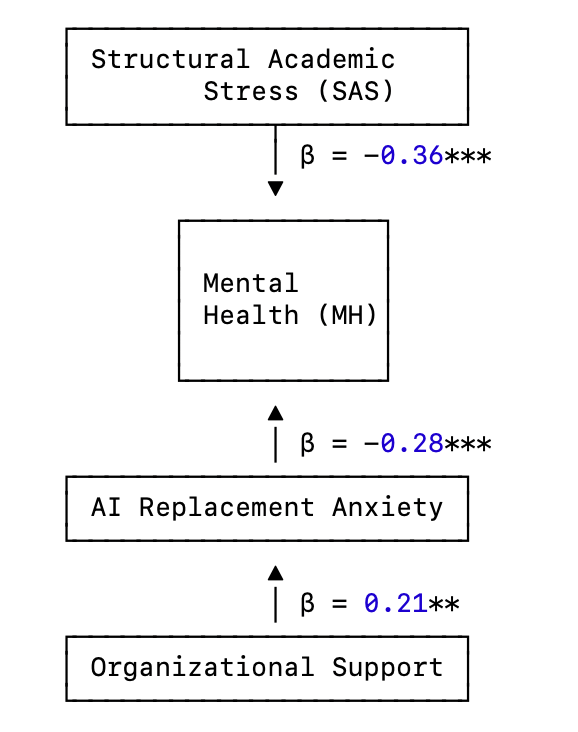
Table 4 and Figure 1 show that both structural academic stress and AI replacement anxiety had significant negative effects on teachers’ mental health (β = –0.36 and –0.28, respectively). In contrast, organizational support exerted a significant positive influence (β = 0.21). These findings suggest that the decline in teachers’ mental health arises not merely from personal emotional reactions but from the combined effects of institutional pressure and technological uncertainty.Structural academic stress reflects the deep transformation of educational governance. When performance evaluation, research productivity, and resource competition become the main criteria of institutional operation, teachers’ psychological experiences are increasingly constrained by administrative rationality. In this environment, the meaning of academic work gradually shifts from intrinsic fulfillment to compliance with quantitative standards. The negative effect of AI replacement anxiety amplifies this pattern. Teachers face not only institutional pressure from performance metrics but also an existential sense of vulnerability as automation and algorithms begin to challenge their professional value. The resulting combination of institutional and technological stress makes the deterioration of mental health a structural outcome rather than an occasional condition.Conversely, the positive effect of organizational support highlights a potential avenue for psychological recovery. When teachers perceive genuine institutional support through fair resource allocation, transparent communication, and emotional recognition, their psychological well-being can be partially restored. Organizational support thus functions less as an external incentive and more as a balancing mechanism that moderates the tension between systemic rigidity and individual fragility.At a broader level, these results reveal a paradox within contemporary higher education: systems that prioritize efficiency and competition often erode the intrinsic meaning of academic work. Although organizational support provides a degree of compensation, it cannot fully counteract the mental depletion generated by performance-driven governance. The challenge of faculty mental health, therefore, lies not in individual adaptation but in the misalignment between institutional rationality and humanistic values. If governance models continue to privilege quantitative evaluation while neglecting mechanisms for psychological restoration, the decline of meaning and well-being may become an entrenched condition within the academic system.
Mediating Effect Analysis of Sense of Meaning
| Path | Indirect Effect | 95%CI Lower Bound | 95%CI Upper Bound | p value | Conclusion |
|---|---|---|---|---|---|
| Structural Stress→Sense of Meaning→Mental Health | –0.18 | –0.26 | –0.10 | *** | Partial mediation |
| AI Anxiety→Sense of Meaning→Mental Health | –0.14 | –0.22 | –0.07 | *** | Partial mediation |
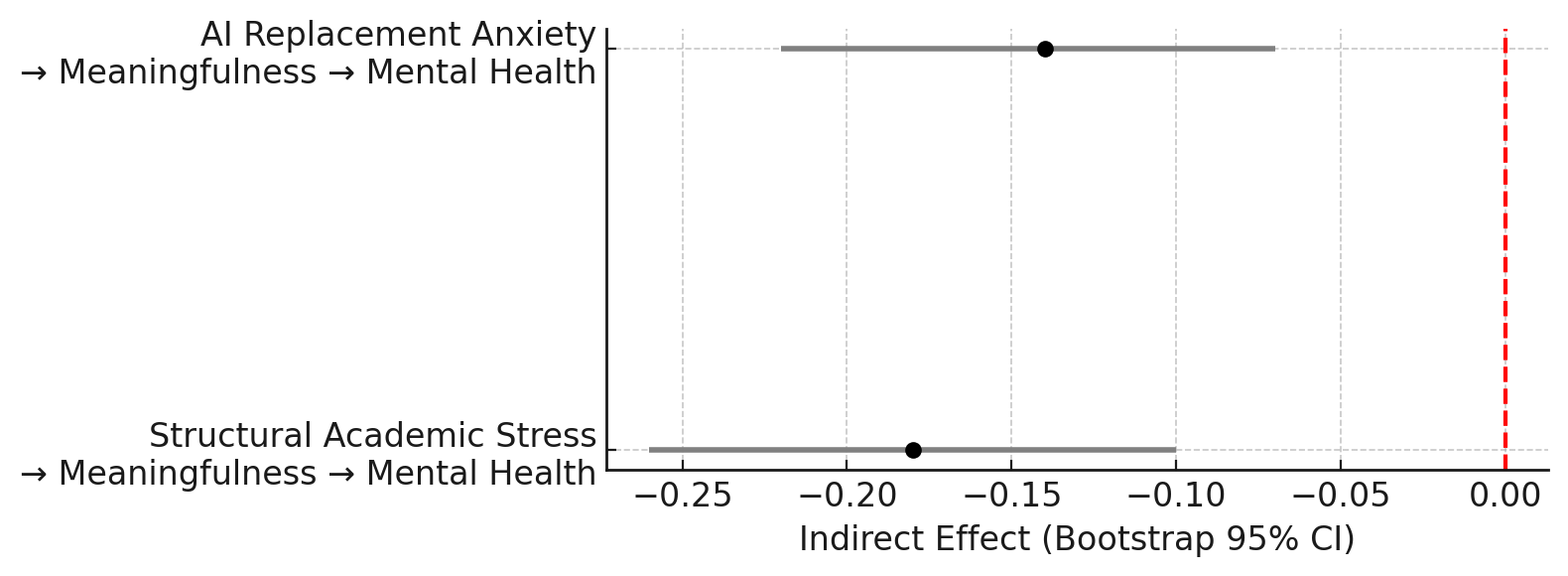
Table 5 and Figure 2 show that sense of meaning played a significant partial mediating role in the relationships between structural academic stress, AI replacement anxiety, and mental health. Structural academic stress indirectly reduced mental health by diminishing teachers’ sense of meaning, with an indirect effect of –0.18 and a 95% confidence interval (CI) from –0.26 to –0.10. For AI replacement anxiety, the indirect effect through the same pathway was –0.14 (95% CI: –0.22 to –0.07). Neither interval included zero, confirming the stability of the mediation effect.These findings demonstrate that sense of meaning functions as a crucial psychological link between external stressors and mental well-being. When teachers lose a sense of purpose and value under performance-driven evaluation systems and continuous technological change, their mental health deteriorates. In this process, external pressures do not directly cause psychological collapse but instead lead to exhaustion and identity confusion by disrupting individuals’ systems of meaning. Once teachers no longer view their work as self-realization but as an obligation within institutional routines, they experience alienation, a sense of emptiness, and eventually burnout.The forest plot in Figure 2 further supports these results: both indirect paths deviate significantly from zero, confirming the mediating role of sense of meaning in channeling psychological energy between stress and health. The partial mediation suggests that teachers retain some capacity for psychological adjustment between institutional and technological pressures. In other words, individuals can partially mitigate stress by reconstructing the meaning of their work.However, the partial nature of this mediation also exposes a systemic paradox. Personal meaning can temporarily repair psychological strain, but it is gradually depleted if institutional structures continue to erode intrinsic professional value. Sense of meaning therefore acts both as a protective resource and as a fragile equilibrium point between institutional rationality and human well-being. Table 4 and Figure 2 together illustrate that, in a highly performance-oriented and technologized academic environment, sustaining mental health depends not only on emotional resilience but on the ability to maintain a socially grounded sense of purpose in educational work.
Moderating Effects of Sense of Meaning and Organizational Support
| Path | β | S.E. | t value | p value |
|---|---|---|---|---|
| Sense of Meaning×Organizational Support→Mental Health | 0.21 | 0.08 | 2.63 | ** |
| Sense of Meaning→Mental Health(Low Organizational Support) | 0.32 | — | — | * |
| Sense of Meaning→Mental Health(High Organizational Support) | 0.61 | — | — | *** |
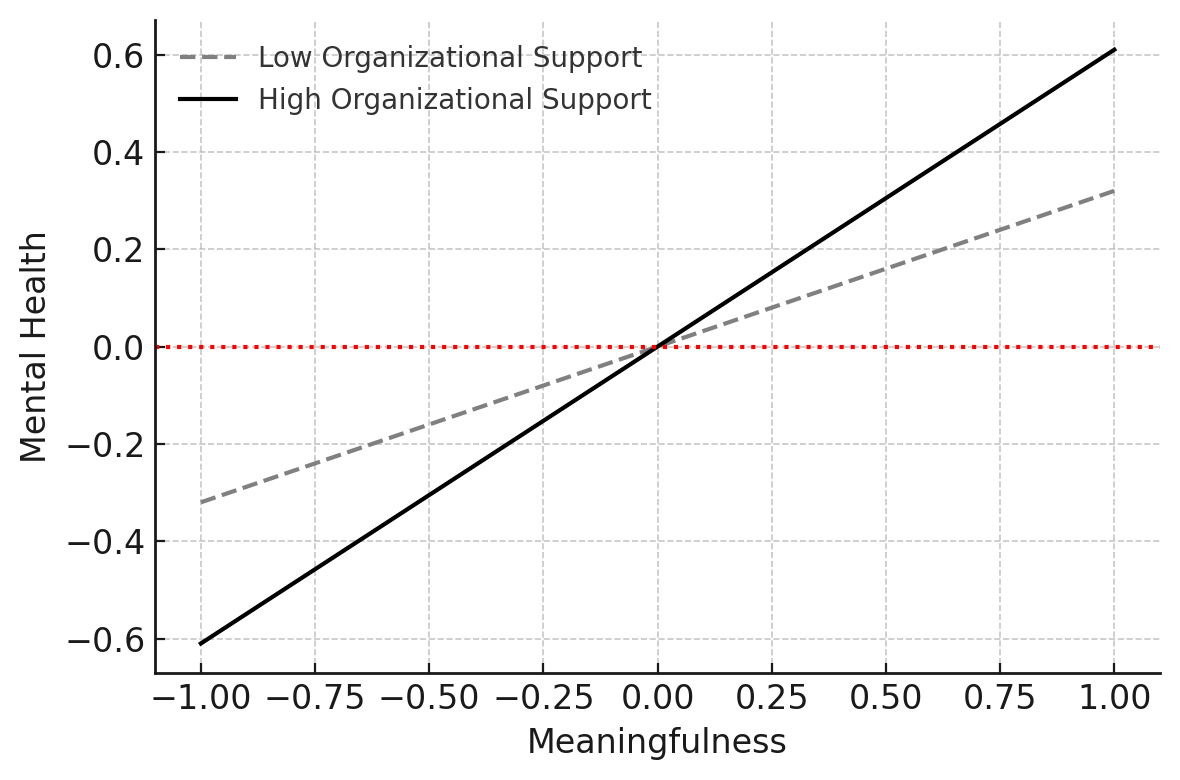
Table 6 and Figure 3 show a significant interaction between sense of meaning and organizational support in predicting mental health (β = 0.21, t = 2.63). Simple slope analysis indicates that under low organizational support, the positive association between sense of meaning and mental health was modest (β = 0.32), whereas this relationship was much stronger when organizational support was high (β = 0.61). As illustrated in Figure 5, the slope for high organizational support is clearly steeper, showing that organizational support amplifies the beneficial effect of sense of meaning on mental well-being.This finding reveals a key interaction between individual psychological resources and the institutional environment. Sense of meaning, as an internal resource, enables teachers to maintain coherence and purpose in high-pressure contexts. However, without external reinforcement, its protective function is constrained by institutional limitations. Under low organizational support, teachers can rely on personal meaning to sustain a certain level of stability, but this form of self-regulation is fragile and mentally costly. When organizational support is strong, by contrast, teachers’ sense of meaning is validated and reinforced by the broader social context, reactivating professional identity and promoting overall psychological health.This moderating relationship reflects the interplay between individual meaning construction and institutional recognition in higher education. Organizational support is not merely a contextual resource but a form of social validation that determines whether personal meaning can be transformed into enduring psychological energy. Sense of meaning therefore exerts its protective influence most effectively in environments where it is both institutionally acknowledged and emotionally affirmed.Taken together, Table 6 and Figure 3 suggest that the sustainability of teachers’ mental health depends on the alignment between internal meaning and external support. When university governance emphasizes performance and competition while neglecting social and emotional support, the positive influence of meaning is weakened by structural indifference. The significance of the moderating effect thus extends beyond a statistical finding—it highlights the need to restore balance between institutional efficiency and human well-being in higher education.
Integrated Structural Model and Robustness Test
| Model Type | χ²/df | CFI | TLI | RMSEA | SRMR | R²(MH) |
|---|---|---|---|---|---|---|
| Main Effect Model | 1.71 | 0.96 | 0.95 | 0.05 | 0.04 | 0.51 |
| Mediating Model | 1.64 | 0.96 | 0.95 | 0.05 | 0.04 | 0.58 |
| Moderating Model | 1.59 | 0.97 | 0.96 | 0.04 | 0.04 | 0.63 |
| Integrated Model | 1.57 | 0.97 | 0.96 | 0.04 | 0.04 | 0.65 |
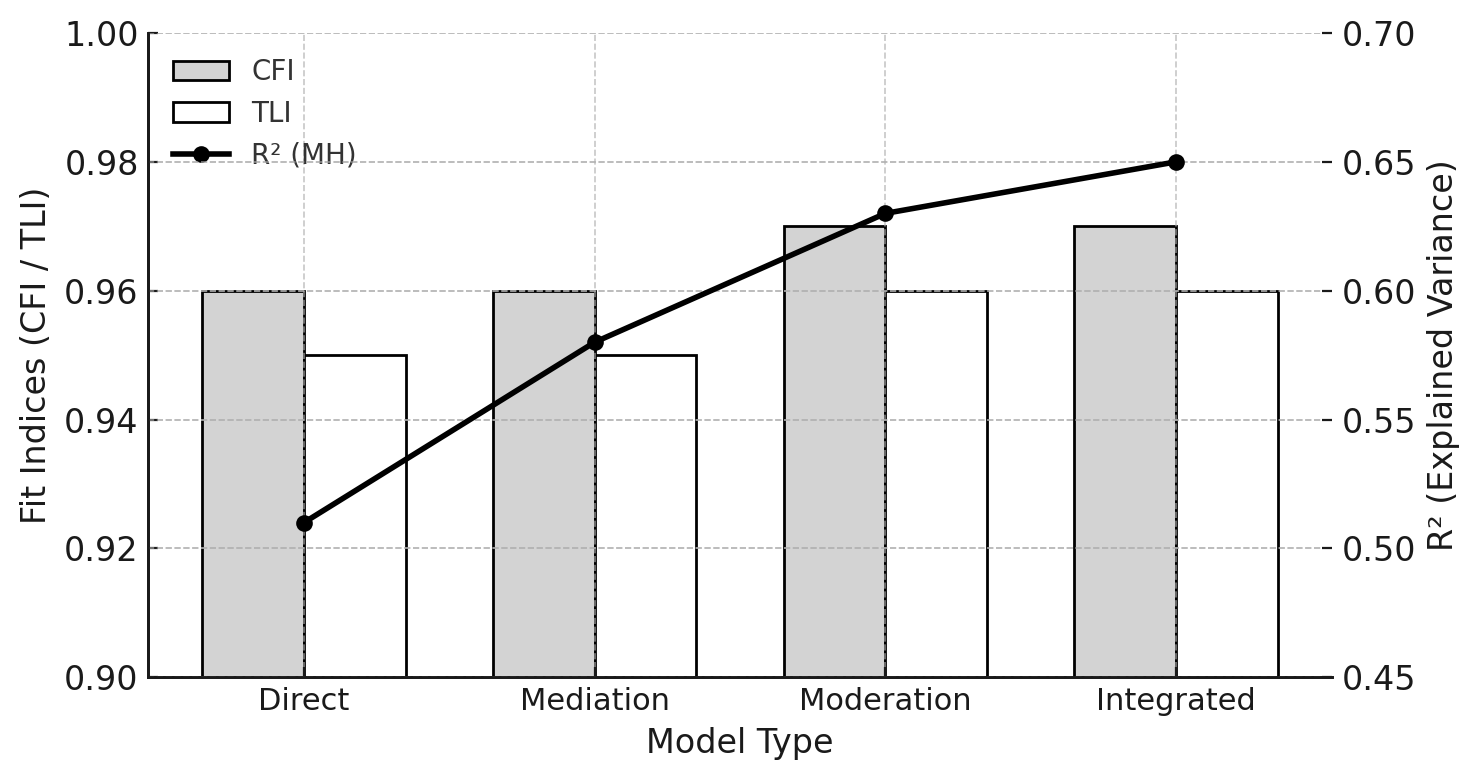
Table 7 and Figure 4 report that all four structural models achieved satisfactory fit levels. The Comparative Fit Index (CFI) and Tucker–Lewis Index (TLI) were consistently above 0.95, while the Root Mean Square Error of Approximation (RMSEA) and the Standardized Root Mean Square Residual (SRMR) remained below 0.05, indicating excellent model fit and stability.In terms of explanatory power, the complexity of the model was positively associated with its ability to explain variation in mental health. The R² value rose from 0.51 in the main effect model to 0.58 in the mediating model, 0.63 in the moderating model, and 0.65 in the integrated model—an overall improvement of nearly 30 percent. This pattern suggests that teachers’ mental health is shaped not by a single stress factor, but by the combined and interactive influences of institutional pressure, psychological meaning, and organizational support.Figure 4 visualizes this trend: as mediating and moderating pathways were incorporated, the explained variance in mental health increased steadily. This pattern indicates that more complex models capture the dynamic interplay of factors within educational environments. The improvement in explanatory power reflects not only methodological refinement but also the underlying structural conditions of higher education. Teachers’ mental health, within performance-driven and technology-oriented systems, emerges as the outcome of interactions among stress, meaning, and institutional support. When meaning is eroded by administrative rationality, the presence of organizational support becomes critical for psychological recovery.
The superior fit of the integrated model confirms both the robustness of the hypotheses and the multidimensional nature of mental health formation. It shows that teachers’ well-being depends on the balance between institutional efficiency and humanistic values. High model fit therefore indicates that including both mediating and moderating pathways better approximates real-world dynamics. Conversely, interventions focused on a single variable are unlikely to address the structural roots of distress. Table 7 and Figure 4 together highlight that the sustainability of faculty mental health depends on an educational system’s capacity to integrate performance goals with psychological and social support mechanisms.
Differential Effects on Multidimensional Mental Health and Alternative Model Analysis
| Mental Health Dimensions | Sense of Meaning→Dependent Variable(β) | SAS→Dependent Variable(β) | AI→Dependent Variable(β) |
|---|---|---|---|
| Emotional Health | 0.58*** | –0.31*** | –0.24** |
| Job Burnout | –0.41*** | 0.36*** | 0.30*** |
| Life Satisfaction | 0.33** | –0.28** | –0.21* |
| Subjective Well being | 0.29** | –0.22* | –0.18* |
Table 8 shows that meaningfulness, structural academic pressure, and anxiety about AI replacement have distinct effects across different dimensions of mental health. Meaningfulness exerts the strongest positive effect on emotional health (β = 0.58), significantly reduces occupational burnout (β = −0.41), and enhances both life satisfaction (β = 0.33) and subjective well-being (β = 0.29). These findings suggest that meaningfulness functions as a central psychological resource that supports teachers’ emotional stability and overall coherence under sustained demands. When individuals find self-realization in their teaching and research, their affect becomes less sensitive to fluctuations in performance evaluation, and burnout is mitigated by a sustained sense of purpose.In contrast, structural academic pressure and AI replacement anxiety negatively affect mental health. Structural pressure shows the strongest positive association with burnout (β = 0.36), indicating that performance-based management continuously drains teachers’ psychological energy. Anxiety about AI replacement more directly undermines emotional health and life satisfaction (β = −0.24 and β = −0.21), reflecting how technological uncertainty reduces feelings of safety and control.Together, these results depict a layered psychological structure: emotional health reflects immediate affective states, burnout captures prolonged depletion, and life satisfaction and subjective well-being represent the longer-term maintenance of meaning. Teachers’ mental health therefore depends less on the absolute level of stress than on their ability to sustain a coherent sense of purpose within institutional constraints. When work becomes detached from value recognition and subordinated to external performance logics, psychological strain accumulates.Within this structure, meaningfulness plays a pivotal role. It serves both as a source of psychological energy and as a stabilizing factor that mitigates institutional alienation. Although its loss may not immediately lead to emotional breakdown, it gradually erodes professional engagement and well-being. The multidimensional pattern in Table 8 implies that improving mental health requires more than lowering stress levels; it also calls for institutional conditions that allow meaning to be preserved and renewed. When educational organizations recognize the intrinsic value of teaching and research and foster genuine professional belonging, teachers’ mental health can be maintained more effectively over time.
Discussion
From Stress Response to Meaning Construction: The Generative Logic of Teachers’ Mental Health
Teachers’ mental health does not follow a simple linear response to external stressors. It represents a continuous process of meaning construction and identity adjustment under high-intensity institutional structures. The results indicate that structural academic pressure and anxiety about AI replacement exert moderate negative effects on mental health (path coefficients ≈ −0.36 and −0.28), yet the overall average level of mental health remains moderately high. This suggests that even in demanding environments, teachers are not entirely depleted; instead, many have developed psychological strategies that allow adaptation and partial reorganization under sustained pressure.In this setting, pressure operates in two ways. It can erode stability when experienced as coercive and unreciprocated, but it can also stimulate self-reflection and renewal when interpreted as a challenge or as recognition of competence. Teachers who view performance expectations and research competition as opportunities for growth tend to mobilize psychological energy, while those who interpret them as threats to autonomy or signs of diminished recognition experience exhaustion and identity tension. These differences highlight the role of meaning as a central psychological mechanism that translates institutional demands into a coherent sense of purpose.The primary risk to mental health, therefore, does not lie in the sheer intensity of pressure but in the disruption of meaning systems. When performance requirements are detached from a sense of moral or educational purpose, pressure becomes punitive rather than motivating. Conversely, when teachers can connect their institutional tasks to personal and professional values, pressure may be transformed into productive engagement.The current trend toward performance management may improve measurable efficiency, yet it also weakens the moral and narrative frameworks through which educators make sense of their work. When teachers lose clarity about the social or personal significance of their roles, their professional vitality diminishes even if surface indicators of performance remain stable. Sustainable psychological resilience, therefore, depends less on endurance than on the capacity to reaffirm the meaning and social value of educational work amid institutional and technological change.
The Rupture between Institutional Rationality and Human Values: Psychological Imbalance under Educational Governance
The findings highlight a contradiction that extends beyond individual stress responses: the growing disjunction between institutional rationality and humanistic values in contemporary higher education. Structural academic pressure and anxiety about AI replacement are not isolated personal experiences but manifestations of a governance logic that has lost alignment with its educational purpose. Empirically, structural academic pressure is strongly associated with occupational burnout (β = 0.36) and negatively correlated with sense of meaning (β = –0.39), while organizational support remains positively related to both meaning and mental health. These results reveal a systemic paradox: a governance framework organized around efficiency, competition, and quantification increasingly undermines the affective and moral foundations that sustain teachers’ creativity, professional identity, and well-being.Under performance-oriented and algorithmic governance, teachers are gradually recast from creators of knowledge to executors of measurable outputs. Education is treated less as an ethical and relational practice and more as a technical process. This shift enforces conformity to data and metrics while weakening teachers’ sense of belonging and integrity. The roots of psychological imbalance therefore lie not only in workload but in a distorted structure of institutional meaning. Teachers are expected to demonstrate enthusiasm and commitment while operating in an environment that discourages emotional engagement and erodes value coherence. Declining mental health thus reflects a moral and institutional imbalance—a widening gap between professional conscience and managerial logic.This imbalance is the foreseeable result of a metric-based regime that equates value with output. By invoking neutrality and scientific objectivity, it reduces educators to production units, turning the erosion of meaning into a structural outcome. Reports of fatigue and emotional exhaustion reflect not only stress but also the gradual displacement of humanistic purpose by technical rationality. In such a system, education risks losing its orientation toward intellectual and moral development, becoming instead a field of resource competition and performance accumulation.Addressing this condition requires more than adjustments to workload or performance targets. Restoring psychological balance depends on rebuilding coherence between institutional goals and the ethical purpose of education. Sustainable reform involves recognizing teachers’ emotional and moral contributions as legitimate forms of institutional value. When governance practices acknowledge human agency and moral responsibility as integral to academic life, mental health can evolve from an individual coping issue into a central dimension of educational sustainability..
From Organizational Support to Institutional Care: Rebuilding the Meaning Ecology of Education
The restoration and maintenance of teachers’ mental health depend on whether universities can move from functional support to institutional care. The analysis shows that organizational support has a significant positive effect on mental health (β = 0.21) and strengthens the beneficial influence of meaning on psychological well-being. This suggests that resilience arises not only from individual self-regulation but also from the sense of safety and recognition created by organizational structures.Yet the prevailing managerial approach in many institutions remains limited to policy-level support—training programs, resource distribution, and incentive mechanisms—while neglecting the deeper ethical dimension of whether teachers are genuinely understood and respected. Sustainable psychological recovery depends less on the quantity of formal initiatives than on whether institutional arrangements convey empathy and recognition.When organizational support develops into institutional care, it becomes part of the moral and cultural fabric of the university. Under such conditions, individuals feel acknowledged and valued even amid structural pressure. Rebuilding this environment of meaning requires redefining the relationship between individuals and institutions. Support framed merely as a distribution of resources or a compensatory mechanism cannot address the foundations of mental health; institutional care, by contrast, concerns how governance structures preserve personal dignity and affirm moral worth.The protective role of meaning lies in the interpretive framework it provides, allowing teachers to situate their work within broader educational purposes. When institutions fail to recognize this meaning, its social grounding erodes: teachers may continue teaching and publishing, yet feel detached and disoriented. The aim of institutional care is to repair this disconnection by linking personal meaning to institutional purpose. Care, in this sense, extends beyond emotional reassurance; it represents a form of ethical governance that assumes responsibility for the psychological and moral well-being of educators.This need arises because current governance systems, driven by efficiency and standardization, have weakened the emotional and social dimensions of education. Teachers’ psychological difficulties should thus be seen not as personal weaknesses but as indicators of institutional environments that fail to provide meaning. When universities once again regard teachers as partners in the educational mission rather than as agents of production, mental health can evolve from compliance-based adjustment to genuine identification with institutional values. Institutional care, therefore, represents a renewal of the educational contract—aligning individual development with organizational purpose and embedding psychological well-being within the culture of the university.
Conclusions
This study examined how structural academic pressure and AI-related replacement anxiety affect the mental health of university faculty, emphasizing the mediating role of meaningfulness and the moderating function of organizational support. The findings indicate that teachers’ psychological well-being results from the interaction among meaning systems, institutional environments, and individual psychological resources. Structural academic pressure and AI anxiety have significant negative effects on mental health, while meaningfulness partially mediates these effects and organizational support provides an important moderating buffer.When teachers face intense performance demands and technological uncertainty, they can maintain psychological balance if they reconstruct meaning to affirm self-worth and experience fairness and emotional recognition from their institutions. Mental health, therefore, depends not simply on external conditions but on whether individuals can make sense of their work and find trust within organizational relationships.At the same time, the results point to a deeper structural issue in higher education. As university governance increasingly relies on performance assessment, quantification, and algorithmic evaluation, the system has advanced in rationalization but lost part of its humanistic foundation. Teachers’ work has become embedded in a logic of output and accountability: their professional value is measured by data, leaving limited space for recognition as moral and intellectual contributors. Education has thus shifted from a vocation grounded in ethics and reflection to a production system, and teachers have been repositioned as implementers rather than creators. Mental health problems should therefore be understood not as failures of personal adjustment but as reflections of a governance model that has grown detached from the educational mission. When efficiency becomes the dominant norm, teachers’ meaning systems narrow, and their emotional and ethical commitments are marginalized.These conditions have produced organizations that appear effective yet are internally characterized by fatigue and disengagement. The deterioration of mental health among teachers has become a systemic signal of the declining humanistic orientation within educational modernization.From a practical standpoint, the study offers three key implications.First, university governance should reorient from performance-driven control toward meaning-centered development, integrating teachers’ mental health into the ethical and cultural foundations of higher education. Institutional design must restore attention to persons, ensuring that teachers are not only evaluated but also respected and understood.Second, institutions need to establish a multilayered structure of organizational care. Fair incentives, participatory management, and emotional support can strengthen teachers’ sense of belonging and professional identity, improving collective resilience.Third, amid rapid technological transformation, education systems should foster constructive engagement with AI, enabling teachers to view technology as a means of innovation rather than a threat to professional identity.Overall, this study clarifies the structural logic shaping faculty mental health and reveals the deeper contradictions within modern higher education. Teachers’ anxiety and burnout reflect not individual weakness but the pressures of a system that prioritizes efficiency over meaning. Sustainable reform requires a renewed commitment to the human dimension of education. The long-term vitality of universities depends on whether they can restore the moral and intellectual purpose of teaching and research, allowing mental health to emerge as a reflection of institutional integrity rather than an individual struggle.
References
Burrows, R. (2012). Living with the h index? Metric assemblages in the contemporary academy. The Sociological Review, 60(2), 355–372. https://doi.org/10.1111/j.1467 954X.2012.02077.x
Derrick, G. E., Watermeyer, R., & Batalla, M. B. (2022). Affective auditing: The emotional weight of the 2022 Research Excellence Framework in the UK. Research Evaluation. Advance online publication. https://doi.org/10.31235/osf.io/c2zn5
Ortagus, J. C., Kelchen, R., Rosinger, K., & Voorhees, N. (2020). Performance based funding in American higher education: A systematic synthesis of the intended and unintended consequences. Educational Evaluation and Policy Analysis, 42(4), 520–550. https://doi.org/10.3102/0162373720953128
Poalses, J., & Bezuidenhout, A. (2018). Mental health in higher education: A comparative stress risk assessment at an open distance learning university in South Africa. International Review of Research in Open and Distributed Learning, 19(2). https://doi.org/10.19173/irrodl.v19i2.3391
Xu, Y., & Wang, Y. (2023). Job stress and university faculty members’ life satisfaction: The mediating role of emotional burnout. Frontiers in Psychology, 14, 1111434. https://doi.org/10.3389/fpsyg.2023.1111434
Wang, Y. Y., & Wang, Y. S. (2019). Development and validation of an artificial intelligence anxiety scale: An initial application in predicting motivated learning behavior. Behaviour & Information Technology, 38(6), 619–634. https://doi.org/10.1080/10494820.2019.1674887
Yam, K. C., Tang, P. M., Jackson, J. C., Su, R., & Gray, K. (2023). The rise of robots increases job insecurity and maladaptive workplace behaviors: Multimethod evidence. Journal of Applied Psychology, 108(5), 850–870. https://doi.org/10.1037/apl0001045
Koch, M., & Lodefalk, M. (2025). Artificial intelligence and worker stress: Evidence from Germany. Digital Society, 4, 5. https://doi.org/10.1007/s44206 025 00160 3
Giuntella, O., König, J., & Stella, L. (2025). Artificial intelligence and the wellbeing of workers. Scientific Reports, 15, 20087. https://doi.org/10.1038/s41598 025 98241 3
Yang, H., & Sundar, S. S. (2025). AI anxiety: Explication and exploration of effect on state anxiety when interacting with AI doctors. Computers in Human Behavior: Artificial Humans, 3, 100128. https://doi.org/10.1016/j.chbah.2025.100128
Allan, B. A., Douglass, R. P., Duffy, R. D., & McCarty, R. J. (2016). Meaningful work as a moderator of the relation between work stress and meaning in life. Journal of Career Assessment, 24(3), 429–440. https://doi.org/10.1177/1069072715599357
Herr, R. M., Brokmeier, L., Baron, B. N., Mauss, D., & Fischer, J. E. (2023). The longitudinal directional associations of meaningful work with mental well being: Initial findings from an exploratory investigation. BMC Psychology, 11(1), 325. https://doi.org/10.1186/s40359 023 01308 x
Yildirim, M., Dilekçi, Ü., & Manap, A. (2024). Mediating roles of meaning in life and psychological flexibility in the relationships between occupational stress and job satisfaction, job performance, and psychological distress in teachers. Frontiers in Psychology, 15, 1349726. https://doi.org/10.3389/fpsyg.2024.1349726
Zhang, J., Chen, Y., Xu, Y., & Li, Y. (2024). Hindrance stressors and turnover intentions among preschool teachers: The mediating role of work engagement and the moderating effect of meaningful work. Heliyon, 10(15), e35366. https://doi.org/10.1016/j.heliyon.2024.e35366
Martela, F., Gómez, M., Unanue, W., Araya, S., Bravo, D., & Espejo, Á. (2021). What makes work meaningful? Longitudinal evidence for the importance of autonomy and beneficence for meaningful work. Journal of Vocational Behavior, 131, 103631. https://doi.org/10.1016/j.jvb.2021.103631
Abraham, V., Meyer, J. C., Mokwena, K. E., & Duncan, E. (2025). Workplace mental health status among academic staff: Psychological distress, burnout, and organisational culture at a South African university. Behavioral Sciences, 15(10), 1410. https://doi.org/10.3390/bs15101410
Agyapong, B., Obuobi Donkor, G., Burback, L., & Wei, Y. (2022). Stress, burnout, anxiety and depression among teachers: A scoping review. International Journal of Environmental Research and Public Health, 19(17), 10706. https://doi.org/10.3390/ijerph191710706
Angelini, G., Mamprin, C., Borrelli, I., Santoro, P. E., Gualano, M. R., Moscato, U., & Fiorilli, C. (2024). Engaged teachers and well being: The mediating role of burnout dimensions. Health Psychology and Behavioral Medicine, 12(1), 2404507. https://doi.org/10.1080/21642850.2024.2404507
Cerci, P. A., & Dumludag, D. (2019). Life satisfaction and job satisfaction among university faculty: The impact of working conditions, academic performance and relative income. Social Indicators Research, 144, 785–806. https://doi.org/10.1007/s11205 018 02059 8
Hammoudi Halat, D., Abdel Rahman, M. E., Al Jayyousi, G. F., & Malki, A. (2024). Associations between perceived occupational stressors and symptoms severity of depression, anxiety and stress among academic faculty: First cross sectional study from Qatar. BMC Psychology, 12(1), 302. https://doi.org/10.1186/s40359 024 01801 x
Koster, M., & McHenry, K. (2023). Areas of work life that contribute to burnout among higher education health science faculty and perception of institutional support. International Journal of Qualitative Studies on Health and Well being, 18(1), 2235129. https://doi.org/10.1080/17482631.2023.2235129
Madigan, D. J., Kim, L. E., Glandorf, H. L., & Kavanagh, O. (2023). Teacher burnout and physical health: A systematic review. International Journal of Educational Research, 119, 102173. https://doi.org/10.1016/j.ijer.2023.102173
Pakdee, S., Cheechang, P., & Thammanoon, R. (2025). Burnout and well being among higher education teachers: Influencing factors of burnout. BMC Public Health, 25, 1409. https://doi.org/10.1186/s12889 025 22602 w
Abeliansky, A. L., Beulmann, M., & Prettner, K. (2024). Are they coming for us? Industrial robots and the mental health of workers. Research Policy, 53(4), 104956. https://doi.org/10.1016/j.respol.2024.104956
Koch, M., & Lodefalk, M. (2025). Artificial intelligence and worker stress: Evidence from Germany. Digital Society, 4, 5. https://doi.org/10.1007/s44206 025 00160 3
Yam, K. C., Tang, P. M., Jackson, J. C., Su, R., & Gray, K. (2023). The rise of robots increases job insecurity and maladaptive workplace behaviors: Multimethod evidence. Journal of Applied Psychology, 108(5), 850–870. https://doi.org/10.1037/apl0001045
Du, Y., Shahiri, H., Wei, X., & Xiahai, W. (2023). “I’m stressed!”: The work effect of process innovation on mental health. SSM – Population Health, 21, 101347. https://doi.org/10.1016/j.ssmph.2023.101347
Kim, B. J., & Kim, M. J. (2024). How artificial intelligence induced job insecurity shapes knowledge dynamics: The mitigating role of artificial intelligence self efficacy. Journal of Innovation & Knowledge, 9(4), 100590. https://doi.org/10.1016/j.jik.2024.100590
Chung, Y. W., Im, S., Kim, J. E., & Yun, J. K. (2025). Artificial intelligence awareness, career resilience, job insecurity, and behavioural outcomes. Australian Journal of Psychology, 77(1), 2559910. https://doi.org/10.1080/00049530.2025.2559910
Yang, H., & Sundar, S. S. (2025). AI anxiety: Explication and exploration of effect on state anxiety when interacting with AI doctors. Computers in Human Behavior: Artificial Humans, 3, 100128. https://doi.org/10.1016/j.chbah.2025.100128
Jalil, M. F., & Ali, A. (2023). The influence of meaningful work on the mental health of SME employees in the COVID 19 era: Can coping strategies mediate the relationship? BMC Public Health, 23(1), 2435. https://doi.org/10.1186/s12889 023 17347 3
Pace, F., Sciotto, G., & Russo, L. (2022). Meaningful work, pleasure in working, and the moderating effects of deep acting and COVID 19 on nurses’ work. Nursing Forum, 57(6), 1258–1266. https://doi.org/10.1111/nuf.12787
Rahman, M. A., Das, P., Lam, L., et al. (2024). Health and wellbeing of staff working at higher education institutions globally during the post COVID 19 pandemic period: Evidence from a cross sectional study. BMC Public Health, 24, 1848. https://doi.org/10.1186/s12889 024 19365 1
Rinas, R., Dresel, M., & Daumiller, M. (2022). Faculty subjective well being: An achievement goal approach. International Journal of Educational Research, 115, 101942. https://doi.org/10.1016/j.ijer.2022.101942
Salavera, C., & Urbón, E. (2024). Emotional wellbeing in teachers. Acta Psychologica, 245, 104218. https://doi.org/10.1016/j.actpsy.2024.104218
Broström, A., Buenstorf, G., & McKelvey, M. (2021). The knowledge economy, innovation and the new challenges to universities: Introduction to the special issue. Innovation: Organization & Management, 23(2), 145–162. https://doi.org/10.1080/14479338.2020.1825090
Sparkes, A. C. (2021). Making a spectacle of oneself in the academy using the h index: From becoming an artificial person to laughing at absurdities. Qualitative Inquiry, 27(8–9), 10778004211003519. https://doi.org/10.1177/10778004211003519
Rosinger, K., Ortagus, J. C., Kelchen, R., & Choi, J. (2023). The impact of performance funding policy design on college access and selectivity. Educational Evaluation and Policy Analysis, 45(1), 3–27. https://doi.org/10.3102/01623737221147905
Maddock, A. (2024). The relationships between stress, burnout, mental health and well being in social workers. The British Journal of Social Work, 54(2), 668–686. https://doi.org/10.1093/bjsw/bcad232
Scholze, A., & Hecker, A. (2024). The job demands–resources model as a theoretical lens for the bright and dark side of digitization. Computers in Human Behavior, 155, 108177. https://doi.org/10.1016/j.chb.2024.108177
Sinval, J., Oliveira, P., Novais, F., Almeida, C. M., & Telles Correia, D. (2024). Exploring the impact of depression, anxiety, stress, academic engagement, and dropout intention on medical students’ academic performance: A prospective study. Journal of Affective Disorders, 353, 151229. https://doi.org/10.1016/j.jad.2024.09.116